Commercial Waste Removal Victoria — Recycling & Sustainability
At Commercial Waste Removal Victoria we design practical plans for an eco-friendly waste disposal area and a sustainable rubbish area tailored to businesses across the state. Our approach balances operational needs with measurable environmental outcomes: efficient sorting, increased reuse, and reduced landfill volumes. We champion a commercial eco-friendly waste removal system that supports councils, business parks and retail precincts in creating a true green waste disposal area.
 Our targets are clear and ambitious: we aim for a 65% commercial recycling percentage target by 2028, rising to 75% by 2035 across partnered sites. This recycling percentage target covers materials diverted from landfill through separation, transfer station processing and redistribution to reuse partners. Boroughs across the region are adopting a consistent approach to waste separation—food organics, paper and cardboard, glass, and mixed recycling—so our collection and transfer strategies align with local separation schemes.
Local Transfer Stations & Strategic Hubs
We coordinate with multiple local transfer stations to keep the eco-friendly waste disposal area network efficient. Typical hubs in our coverage include St Kilda Transfer Station, West Melbourne Transfer Station and Footscray Processing Hub. These transfer stations act as consolidation points where sorted materials are weighed, graded and forwarded for recycling or recovery. By routing loads to the correct local transfer stations, our sustainable rubbish area footprint is reduced through shorter hauls and better material throughput.
 To support practical separation, our teams work with council and private-site managers to run separation schemes onsite. Common sorting streams supported include:
- Food organics and garden organics (FOGO)
- Mixed recyclables: paper, plastics & glass
- Hard-fill and inert materials for recycling or recovery
Charity Partnerships & Reuse Programs
 We have formal partnerships with local charities and social enterprises to expand reuse and community benefit. Items suitable for reuse — office furniture, small appliances, textiles and gently used fixtures — are diverted to partners such as St Vincent de Paul, Salvation Army ReStores and regional community rehabilitation programs. These collaborations reduce waste, help vulnerable communities and keep functional goods circulating within a circular economy rather than an unsustainable rubbish cycle.
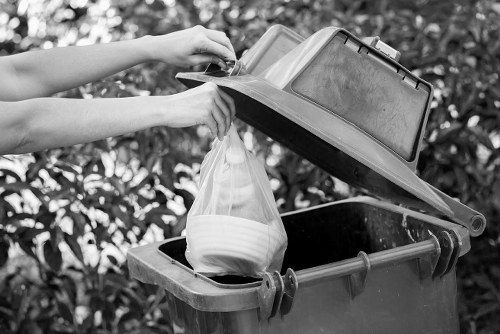 Our donation and salvage pathways are designed to meet both environmental and social objectives. Before materials are classified as 'residual', trained crews assess for reuse potential. When items are reusable, they are catalogued, transported to charity partners or listed with social enterprise refurbishers. In this way our sustainable waste area becomes a source of social value, not just a cost centre.
Low-carbon transport is a cornerstone of a genuinely eco-friendly rubbish area. Our fleet includes electric vans, plug-in hybrids and Euro 6 diesel vehicles upgraded to low-emission standards. We deploy route optimization software that reduces empty running, clusters pickups for high-density commercial zones and schedules collections to avoid peak congestion. Combined, these measures cut carbon intensity per tonne of waste managed and support our low-carbon vans commitment.
Operational sustainability also extends to driver training, payload optimization and maintenance standards that extend vehicle lifespans. By investing in low-emission vehicles and smarter logistics we reduce greenhouse gas emissions from the collection phase while maintaining reliable service for business customers in retail, hospitality, construction and industrial sectors.
Performance is tracked through quarterly sustainability reports that measure diversion rates, greenhouse gas reductions and charity recoveries. Our teams set site-level recycling percentage targets that roll up to the overall commercial recycling percentage target and are adjusted based on seasonal waste flows and council policy changes. Transparency ensures clients and partners can see progress toward a shared sustainable rubbish area goal.
Our technicians and account managers collaborate with local boroughs to align site sorting rules with municipal requirements. This boroughs approach to waste separation reduces contamination and increases the value of collected recyclables. We provide signage templates, bin allocations and staff briefings that make correct sorting intuitive for employees and contractors onsite.
Waste hierarchy principles guide decisions: avoid, reuse, recycle, recover and dispose as a last resort. Where avoidance is impossible, we prioritise reuse pathways and material recovery facilities. That makes every commercial eco-friendly waste disposal area we service part of a broader circular economy loop.
Finally, we maintain emergency response protocols for hazardous or contaminated loads and ensure all transfer station movements comply with environmental regulations. Strong governance, community partnerships and low-carbon vans together create a sustainable commercial waste area that supports business continuity, reduces environmental impact and returns value to the community.
By combining targeted recycling percentage targets, local transfer stations, charity partnerships and an expanding fleet of low-emission vehicles, Commercial Waste Removal Victoria delivers a pragmatic, scalable route to a greener, more efficient eco-friendly waste disposal area for businesses of all sizes. Our commitment is to turn waste into resources and to create sustainable rubbish areas that benefit both the environment and the community.
